For government contractors
WinBridge runs the pipeline. You review, approve, and sign.
A self-running business development engine for government contractors. It finds the solicitations, scores them against your profile, drafts the proposals, and runs the outreach, so your team spends its hours on the calls that win, not the busywork that doesn't.
1 The idea
Most contractors go hunting for work. WinBridge makes the work come to you, already scored and already written.
WinBridge is built for the teams that live and die by the next award: small and mid-size government contractors who can't afford to miss a fit, or to burn a week writing a proposal that loses. It watches the market for you, tells you what's worth pursuing, and hands you a draft that's already grounded in your own record, so your people spend their time deciding and closing, not searching and formatting.
One engine, four moving parts. Two pipelines feed a proposal engine, and a build tier turns an approved win straight into a working solution.
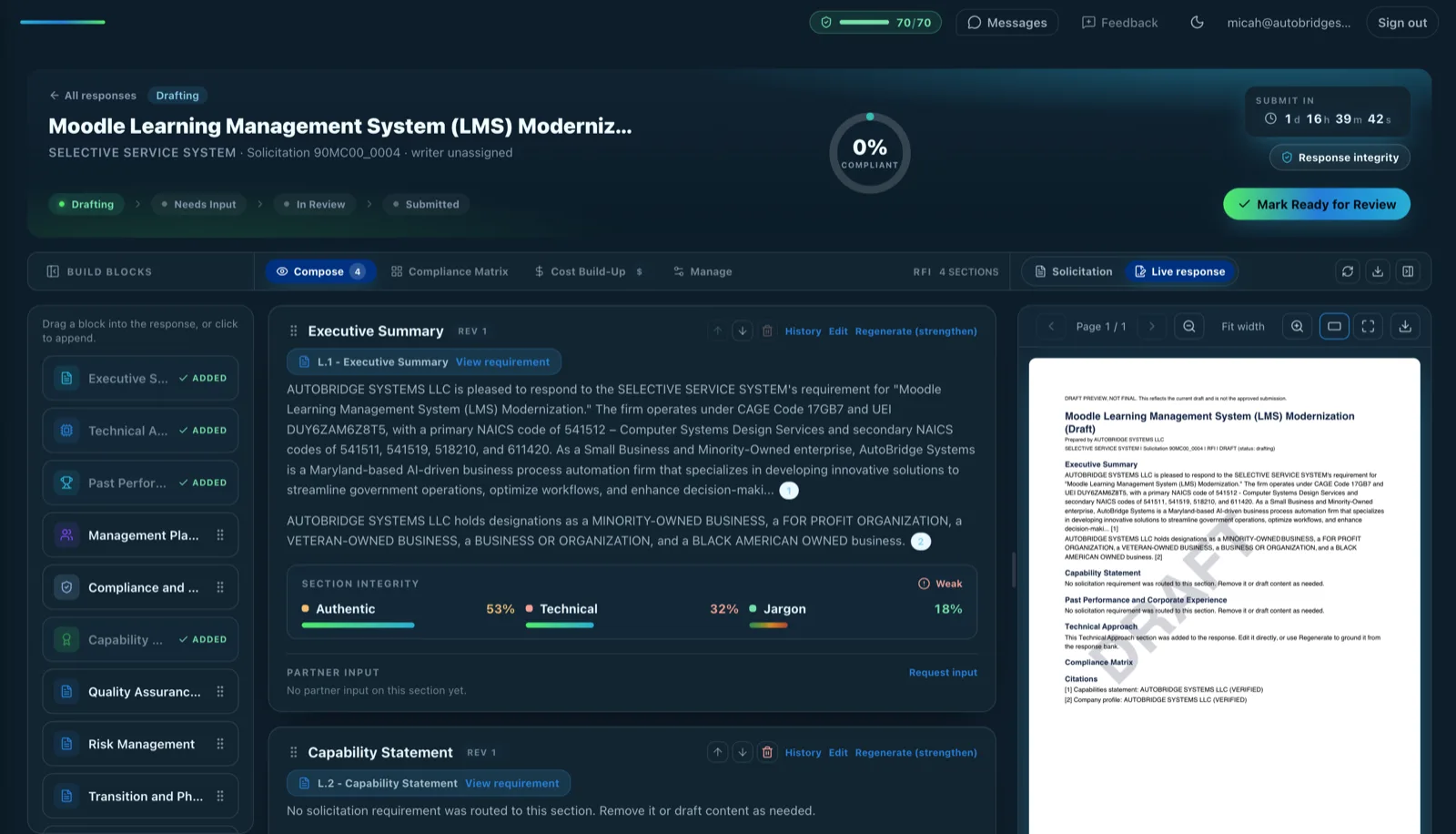
Reads the solicitation, builds a compliance matrix, and drafts every section from your real capabilities. Your team edits and approves.
One click takes an approved opportunity and starts building it, so you can demo a working solution before the award is even decided.
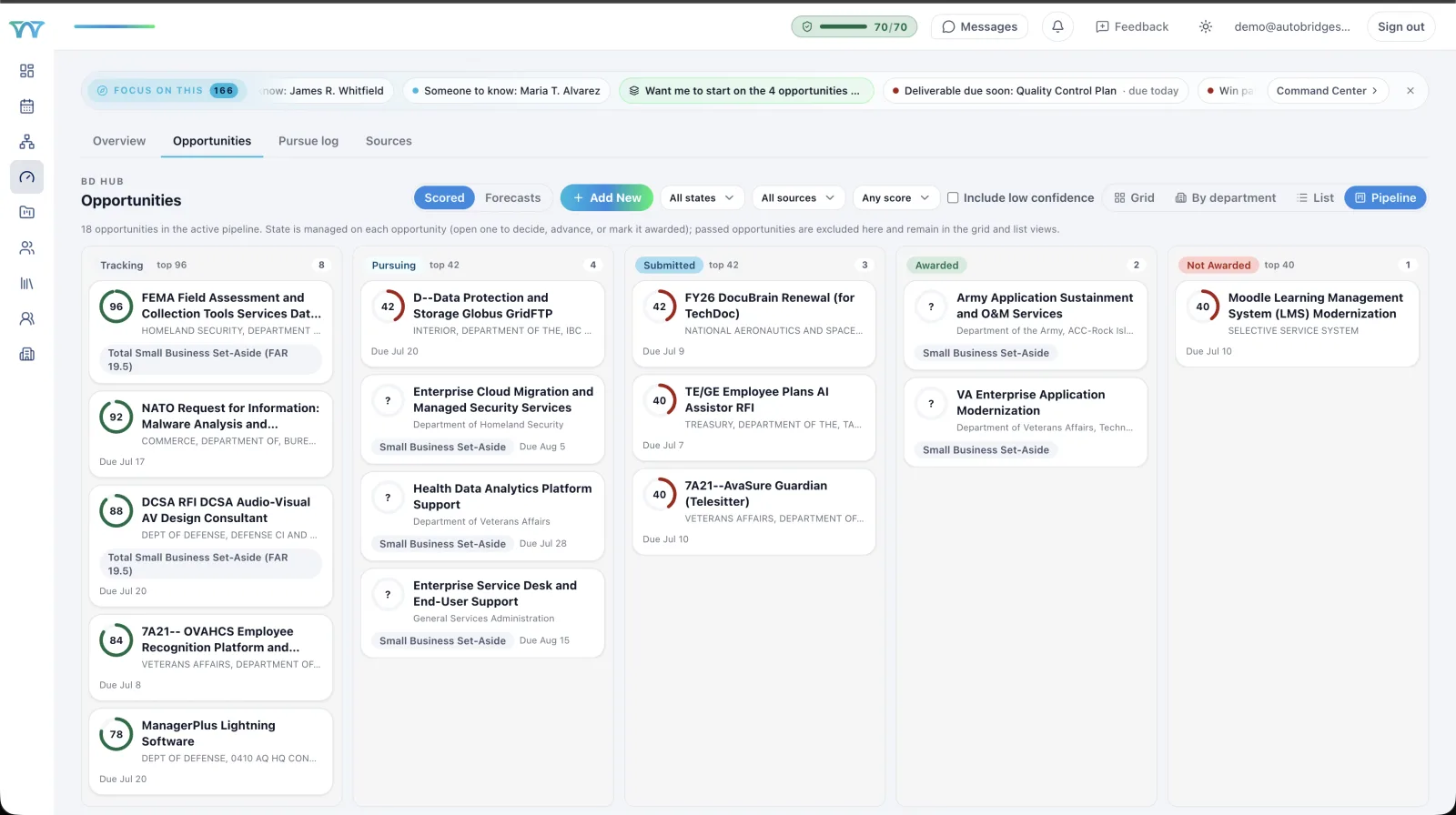
Your whole pipeline in one view: scored, staged, and always current.
2 The learning loop
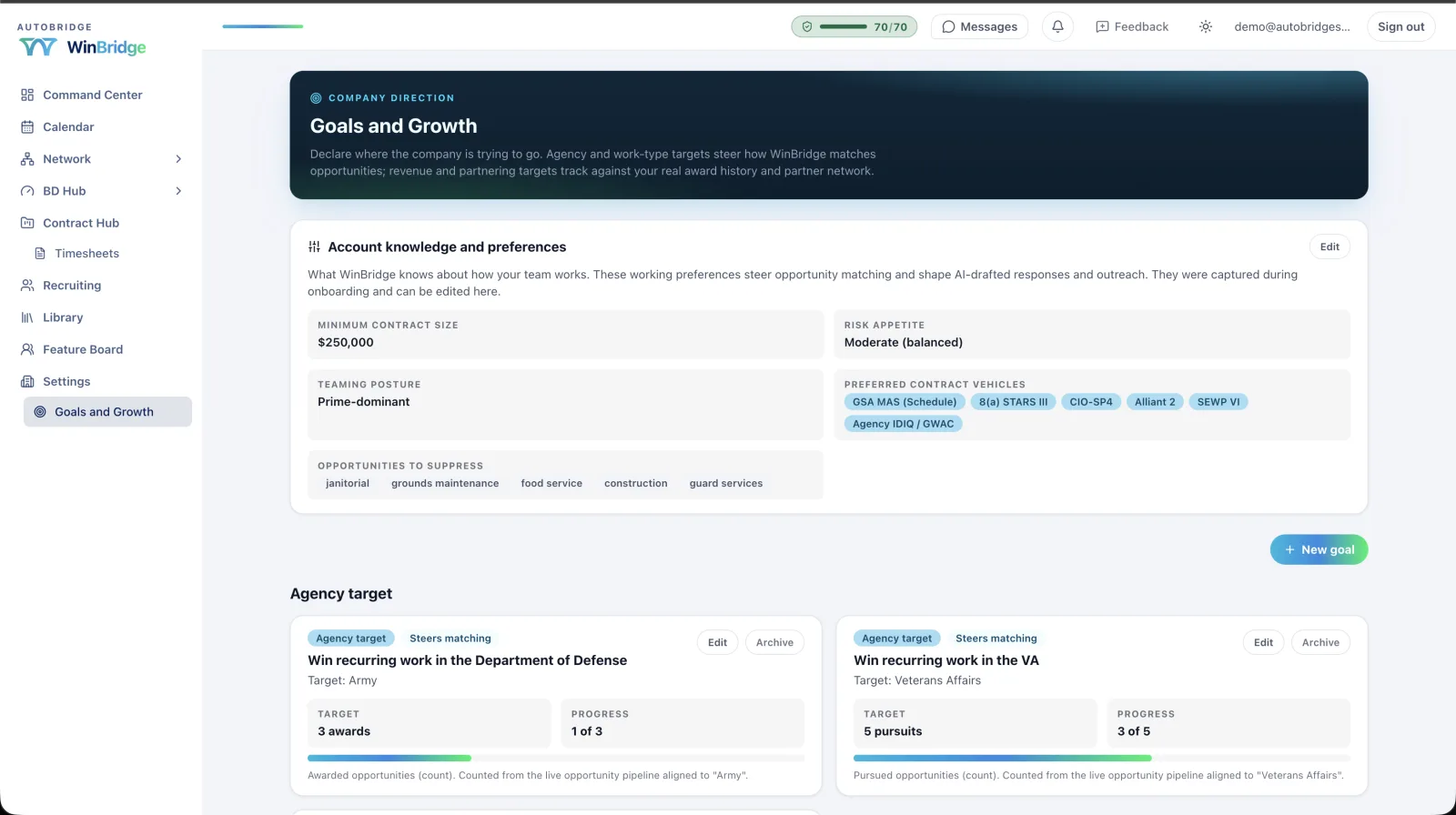
WinBridge's intelligence runs on NURO, AutoBridge's continuous learning engine. NURO learns from every proposal you draft, every partner you team with, and every win and loss you log, then updates where WinBridge focuses next. Your goals are its guide: it doesn't just react to what's posted today, it keeps steering the pipeline toward where you said you're going.
The loop never stops: what it learns about your proposals sharpens your matches, what it learns about your partners sharpens your teaming, and every outcome makes the next recommendation closer to the win.
3 The difference
Finding opportunities is table stakes now. The graph underneath is the product.
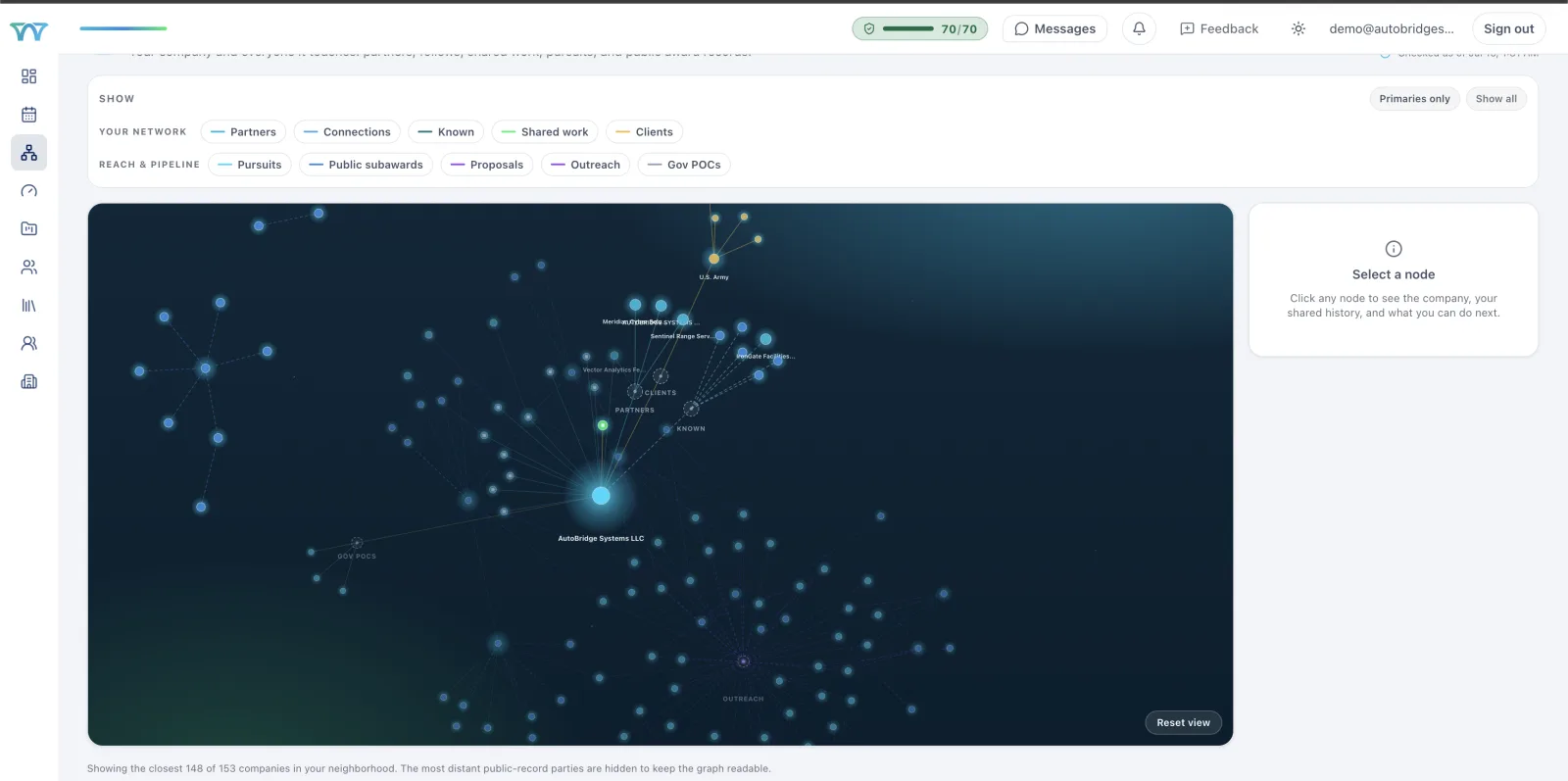
Every tool in this space can say the same sentence: it finds opportunities and drafts a response with AI. That's the starting line, not the finish. WinBridge's intelligence layer keeps making new connections toward your win: it learns your goals, learns your partners, and builds a living graph of how they connect. Then, as you win and lose, it updates what it pursues, who it reaches out to, and which partners it puts in front of you, so the graph keeps finding a shorter path to the next award.
The agencies you want, the vehicles you hold, the work you do best. The graph is anchored to where you're trying to go, not just what's posted today.
Teaming partners, primes, and subs become nodes in the same graph, so WinBridge can see which relationship opens which door, and surface the partner that turns a maybe into a bid.
Each win and loss re-weights the graph. Targeting sharpens, outreach adjusts, and the connections it recommends get closer to the ones that actually convert.
The connections between your goals, your opportunities, and your partners, live.
Set where you're headed. The graph works backward from there.
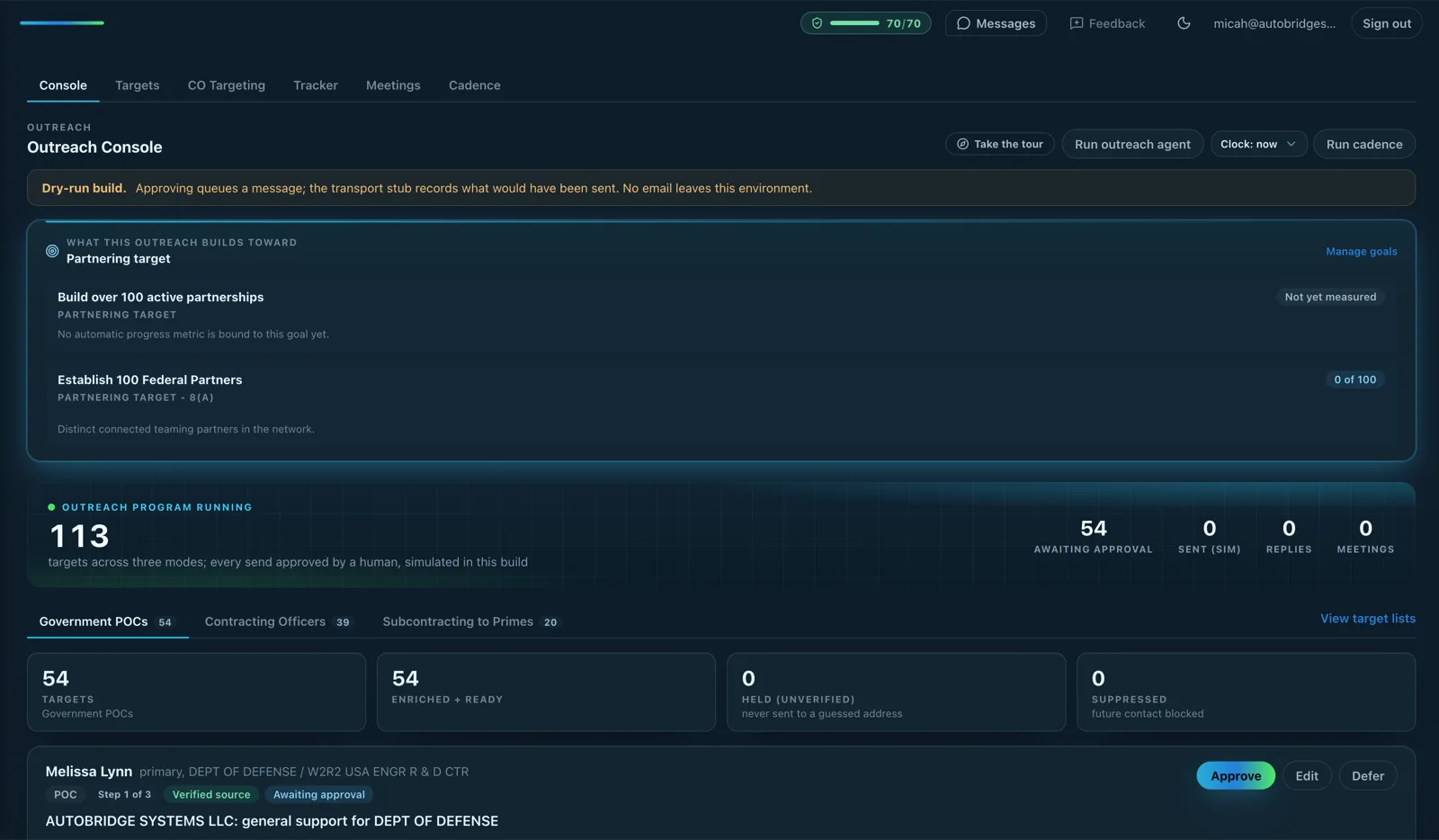
Outreach that adjusts to who's actually moving you toward a win.
4 What it does
From the profile that tunes everything to the analytics that prove it's working.
CAGE, UEI, designations, capabilities, past performance, NAICS, and a solution catalog. A live readiness score tunes pipeline quality.
Continuous SAM.gov scanning, then a composite fit score per opportunity with a pursue, consider, or pass call. Weak matches never reach you.
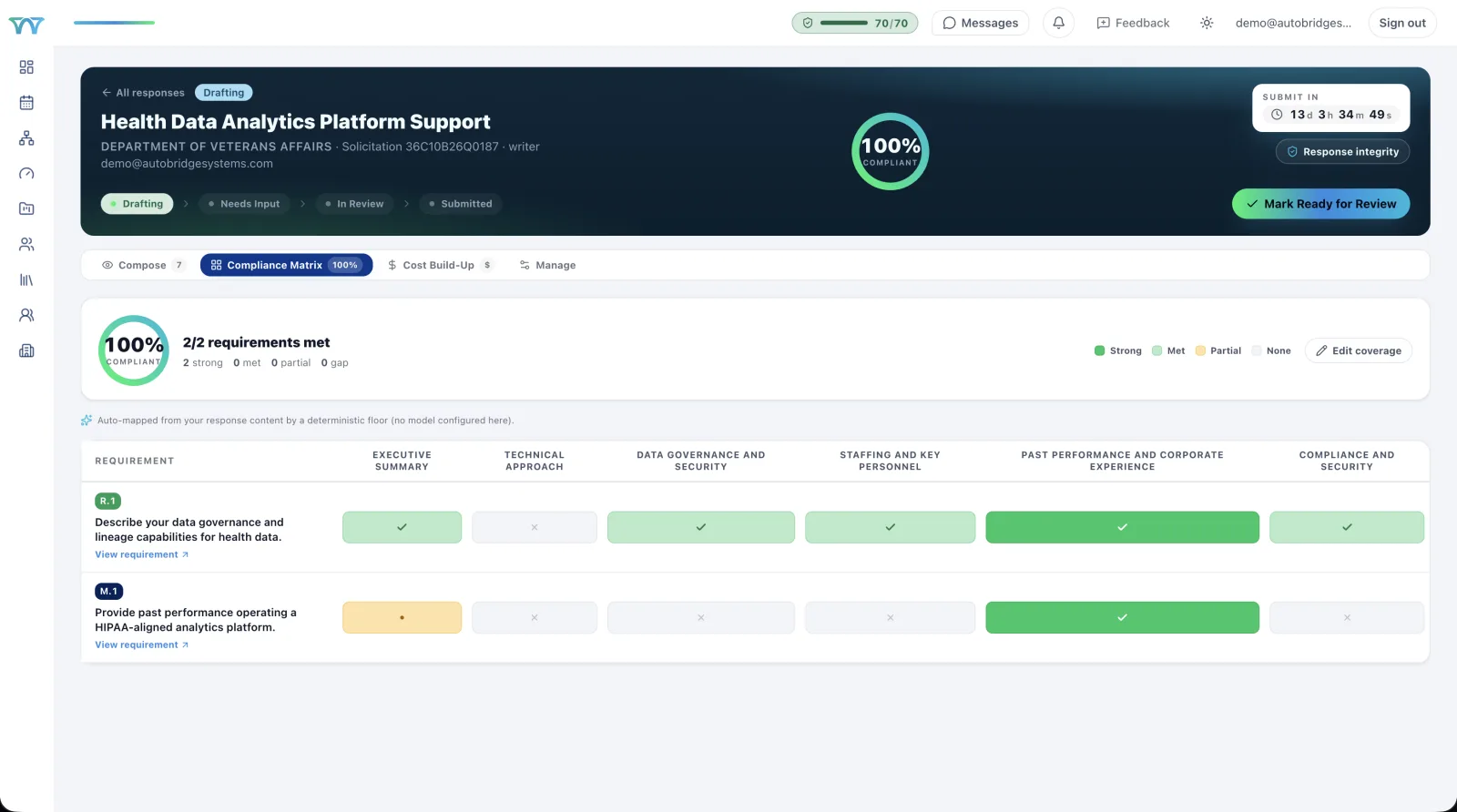
A requirements compliance matrix plus every section drafted from your real evidence in under five minutes, with flagged gaps to fill.
Finds and enriches the right government POCs, drafts personalized email with a matched demo, and tracks replies and follow-ups to conversion.
Draft to review to executive sign-off, locked and exported submission-ready as DOCX, PDF, or ZIP. Four roles, full audit trail.
Outcomes feed match calibration. Dashboards cover win rate, pipeline value, the outreach funnel, and time-to-draft.
Agents that watch the whole graph and propose the next move: the opportunity to pursue, the person to reach, the partner to bring in. They never fire on their own; every action waits for your approval.
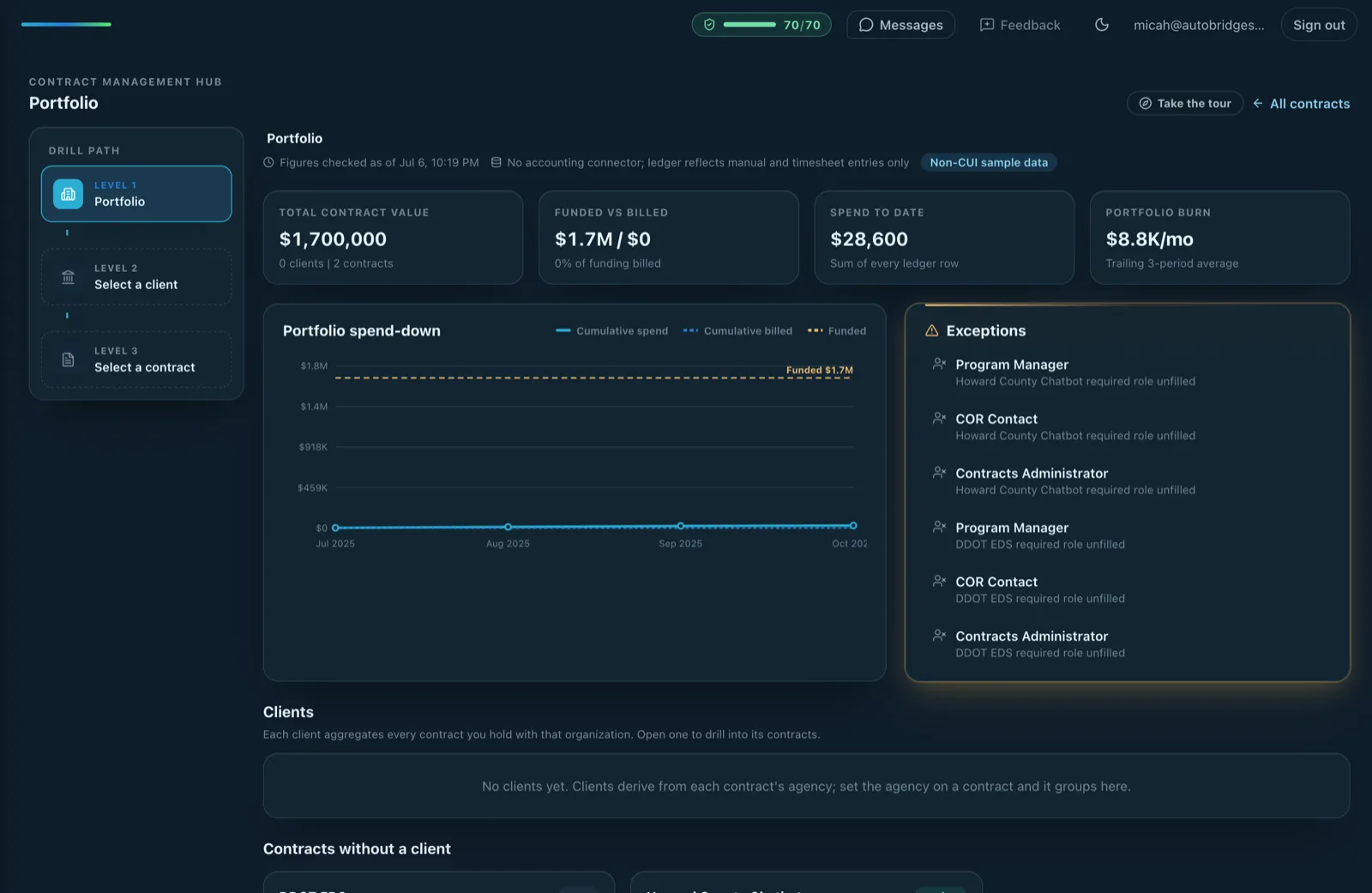
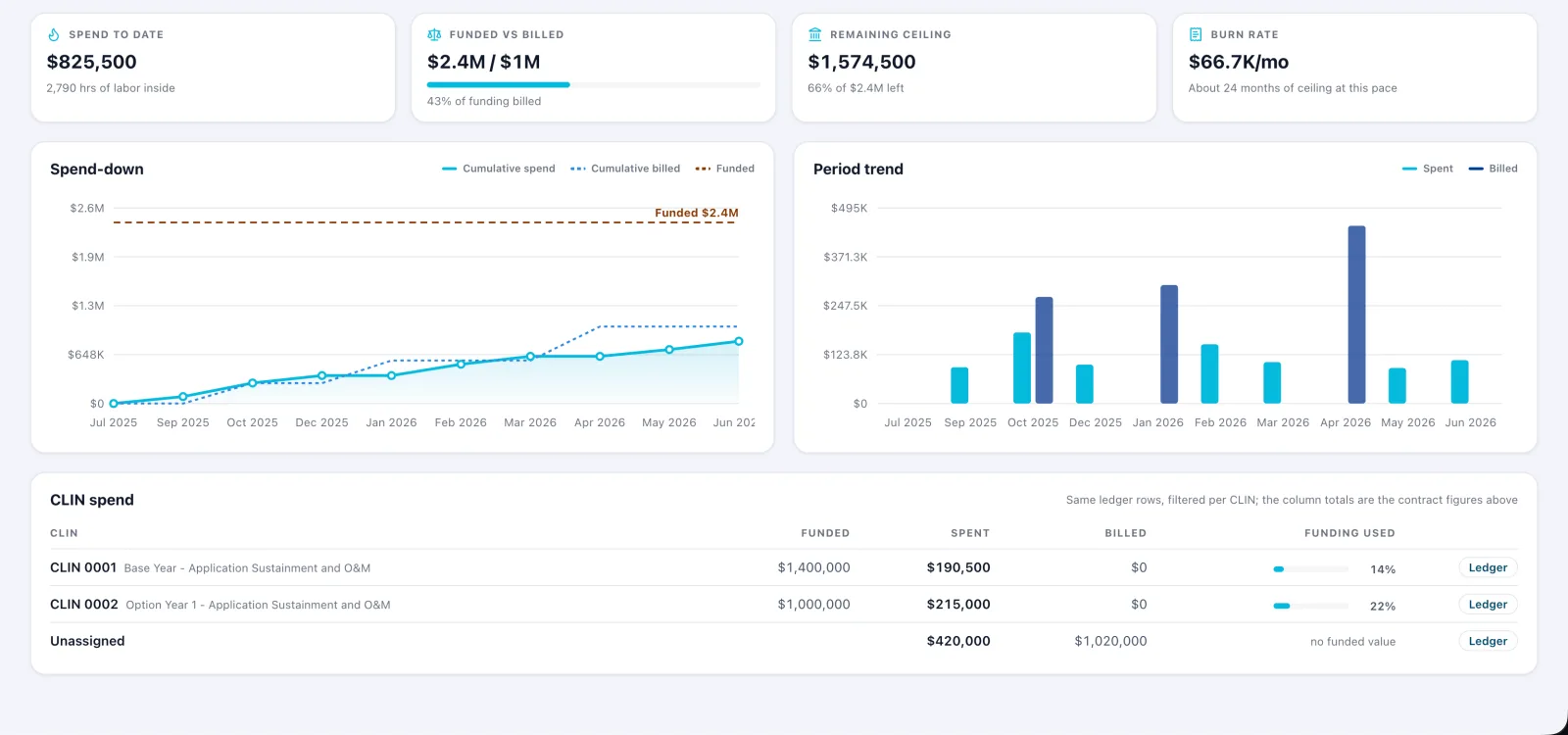
Post-award lives here too: portfolio and per-contract financials, spend-down against funding, CLIN tracking, burn rate, and required-role exceptions before they become findings.
Win the work, then staff it. A recruiting pipeline tied to your contracts, so key-personnel and required-role gaps are filled before performance starts.
Draft every section, grounded in your real evidence.
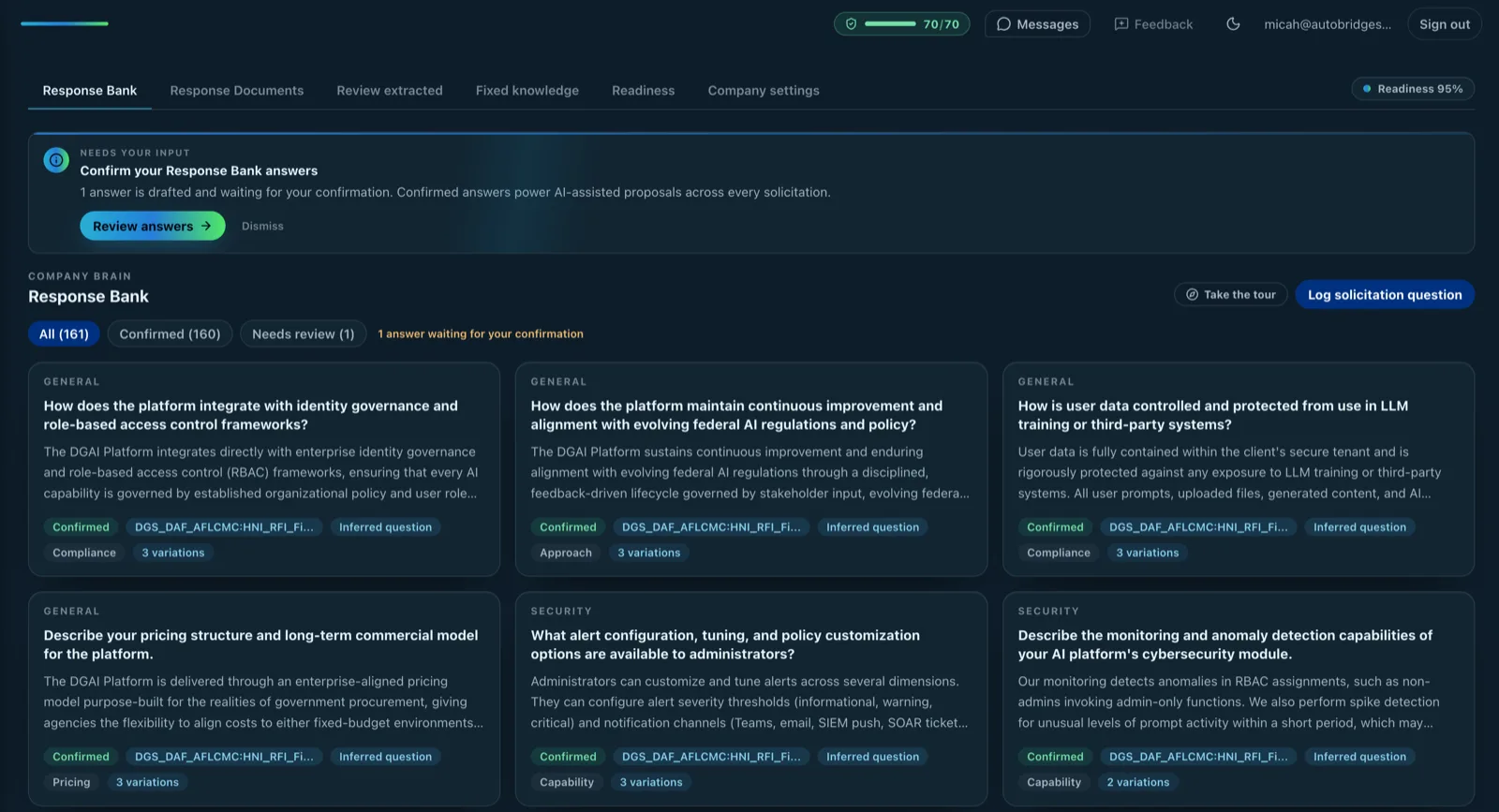
Reuse your best answers and past performance.
5 The connected system
WinBridge plugs into the systems that source the work, reach the right people, and keep it all secure, so it fits the way your team already operates.
Already subscribed to premium market intel, or running a DCAA-compliant accounting system? Connect it. WinBridge folds your existing subscriptions and systems into the same graph, so the intelligence gets richer without changing how your back office runs.
6 How it flows
Every opportunity rides one tracked lifecycle, with a build branch breaking off to turn the win into a working solution.
At Pursuing or Submitted, one click starts building the solution (specify, plan, build), with progress syncing back so you can demo before the award.
Complete the guided wizard. Clear the readiness gate and the account activates, SAM.gov sync starts, and the build tier connects.
New solicitations arrive on schedule; the AI engine scores each; high-fit ones surface and notify. Pick Pursue, Watch, or Pass, which kicks off the proposal engine.
The engine reads the solicitation and your profile, drafts every section grounded in evidence, and flags gaps. Writer edits, Exec approves, export submission-ready.
Discovery sources and tags POCs; the AI drafter personalizes each email with a matched demo. Approve the campaign, then tracking handles replies and follow-up cadence.
Package an approved opportunity and it starts building. Progress syncs at each phase; when it deploys, share a live demo URL with the agency before the decision.
Every contract you hold, tracked in one portfolio.
Track the value behind every award, not just the count.
7 The agent layer
Atlas works the graph for you. Powered by NURO.
Atlas is the agent surface over everything above: agents that read the graph NURO keeps learning, and turn it into proposed next moves across your whole operation. Every proposal waits at a gate for a human yes. Nothing irreversible fires without you.
Watches discovery around the clock, scores each opportunity against your profile and goals, and proposes the pursuits worth your hours.
Builds the compliance matrix, drafts every section from your real evidence, and keeps your response bank sharp between pursuits.
Proposes the government contact to reach, the message to send, and the teaming partner that turns a maybe into a bid.
Watches your contracts after the win: recompete clocks, spend against funding, unfilled required roles, and the deliverable due before it's due.
8 Built for trust
The platform holds CAGE codes, pre-decisional pricing, and government PII, so it's built to a federal bar from day one. Aligned to NIST 800-53 Rev 5 (Moderate), with the rest on the roadmap.
A full STRIDE threat model backs the platform: every attack surface mapped, every threat tracked, and mitigations owned.
Every requirement mapped and met, line by line.
The bottom line
WinBridge finds the work, scores it, drafts the response, and runs the outreach, leaving your people to approve and sign. And underneath it all, a graph that keeps learning your goals, your partners, and your wins, so the next opportunity is a little closer than the last.